.png)
If you own films, documentaries, web series, or an entire production catalogue, building your own OTT platform can seem like the obvious next step.
You have the content.
You want an audience.
So why not build your own Netflix?
The problem is that owning content and operating a streaming platform are two different businesses.
An OTT platform requires technology, infrastructure, payments, video delivery, security, applications, maintenance, customer support, and audience acquisition. Your actual objective may simply be to get your content in front of paying viewers.
That creates an important question:
What are the alternatives to building your own OTT platform?
For filmmakers and production houses, there are several ways to distribute and monetize content without taking on the full responsibility of building and maintaining streaming infrastructure.
First: What Are You Actually Trying to Build?
Before choosing a distribution model, separate these two objectives.
Option 1: Build a streaming business
You want to operate a platform where users come specifically to consume a large catalogue of content.
In this case, owning or heavily customizing the technology may make sense.
Option 2: Build a content business
You already produce or own content and want to:
Distribute films
Reach audiences
Sell premium videos
Monetize an existing library
Build direct customer relationships
In this case, building an OTT platform may not be necessary.
The technology is a means to an end—not the product you are actually selling.
7 Alternatives to Building Your Own OTT Platform
1. Use a Premium Video Commerce Platform
For many filmmakers and production houses, this is the most direct alternative.
Instead of building your own streaming infrastructure, you use an existing platform designed to help content owners distribute and monetize premium video.
The platform handles much of the technology while you focus on your content and audience.
This approach can provide access to capabilities such as:
Video hosting and distribution
Transactional Video on Demand (TVOD)
Payments
Content discovery
Analytics
Secure distribution
Copyright protection
Creator tools
VideoMart's knowledge base describes it as a video commerce platform and premium video experience platform that enables creators and organizations to distribute, monetize, and sell entertainment and learning experiences directly.
Its underlying philosophy is straightforward:
Videos are products. Creators are merchants. Audiences are customers.
For a production house, this changes the question from:
"How do we build an OTT?"
to:
"How do we get our content into the hands of paying audiences?"
2. Sell Individual Films Through TVOD
You don't necessarily need a subscription streaming service to monetize a film.
With Transactional Video on Demand, viewers pay for individual content.
For example:
Film → Product → Purchase → Watch
This can be particularly relevant for:
Independent films
Documentaries
Regional cinema
Festival films
Special releases
Niche productions
Instead of trying to convince someone to subscribe to an entire catalogue, you give them the option to pay for the specific film they want to watch.
VideoMart identifies TVOD and pay-per-view as core monetization models for premium video content.
3. Monetize Your Existing Film Library
Your newest film doesn't have to be your only source of digital revenue.
Production houses may already have years of content sitting in their catalogue.
That could include:
Feature films
Short films
Documentaries
Web series
Concert recordings
Event recordings
Regional productions
Instead of treating this material as an archive, treat it as a collection of digital products.
A production house with 50 films doesn't necessarily need 50 new productions to create more revenue opportunities.
It can find new audiences for the films it already owns.
4. Use Direct-to-Audience Distribution
Another alternative is to distribute content directly to viewers rather than relying exclusively on traditional distributors or large streaming services.
The basic model is:
Create → Publish → Promote → Sell → Build audience
This gives content owners greater control over:
Pricing
Release timing
Catalogue availability
Audience relationships
Monetization
VideoMart's positioning specifically emphasizes direct monetization and creator ownership rather than dependence on algorithms or traditional gatekeepers.
5. Build a Branded Audience Without Building the Infrastructure
There's an important distinction between owning a brand and owning every piece of technology behind the brand.
A production house may want audiences to recognize its name, films, catalogue, and creative identity.
That doesn't necessarily mean it needs to build:
Its own CDN
Its own payment infrastructure
Its own video processing system
Its own DRM architecture
Its own recommendation engine
Its own mobile applications
The alternative is to use existing infrastructure while concentrating investment on:
Content
Branding
Marketing
Audience development
New productions
This is similar to how many businesses use specialized infrastructure instead of building every underlying technology component themselves.
6. Create Paid Collections Instead of a Full OTT Service
You don't always need a huge catalogue to create a premium viewing experience.
Consider organizing content into collections such as:
Director Collection
All films from a particular director.
Regional Cinema Collection
Films from a specific language or region.
Documentary Collection
A curated selection of documentaries.
Festival Collection
Films associated with a particular festival or theme.
Franchise Collection
Multiple films from the same story universe.
This turns an existing catalogue into multiple commercial packages without requiring a completely separate streaming platform.
7. Combine Free Discovery With Paid Content
Another alternative is a hybrid content strategy.
Free content can help people discover your brand.
Paid content can generate revenue.
For example:
Free trailer
↓
Free behind-the-scenes clip
↓
Film preview
↓
Paid full film
↓
Additional premium content
This creates a path from audience discovery to purchase.
The objective isn't to eliminate free content.
It's to make sure free attention has a logical path toward paid value.
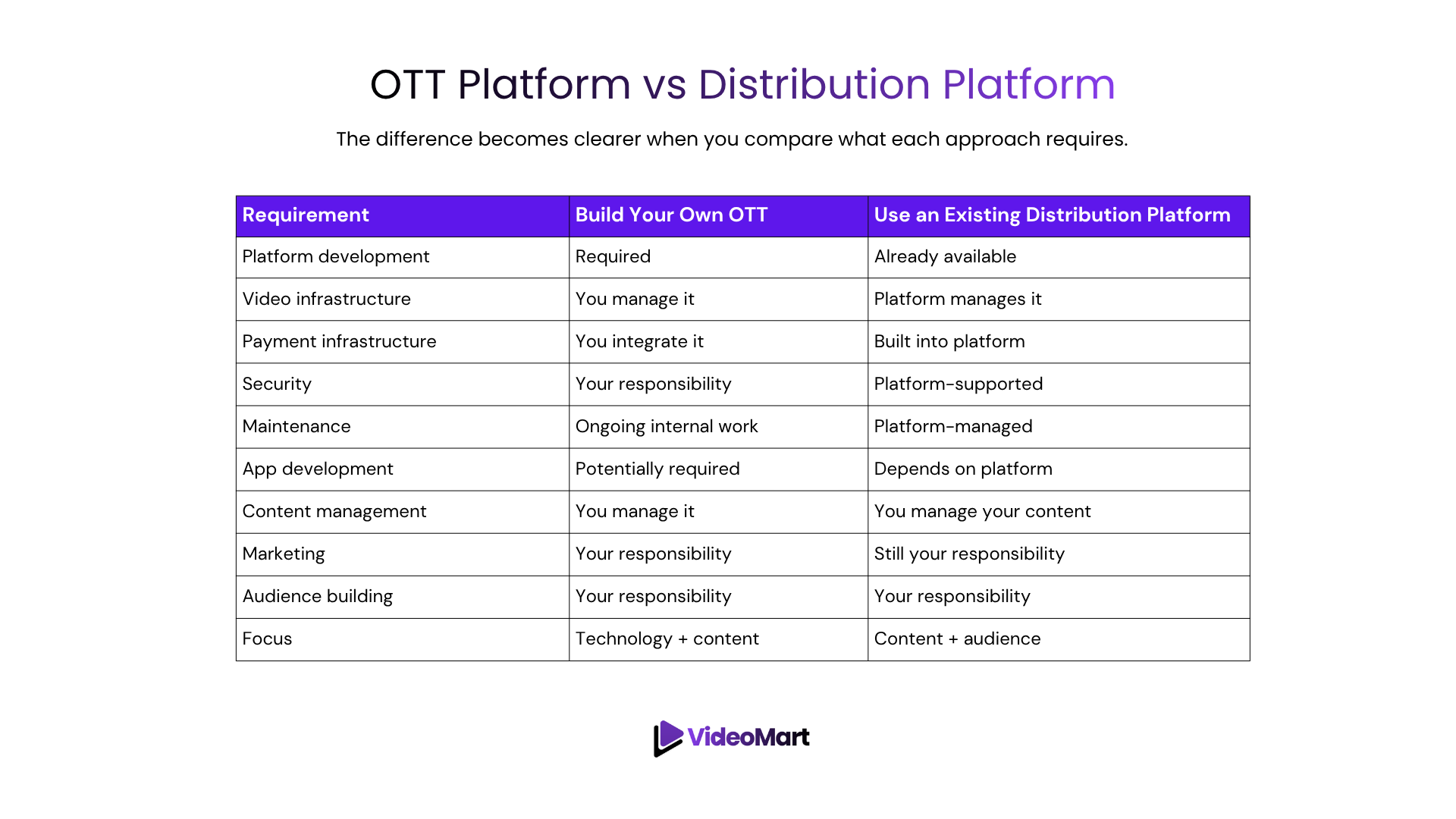
One important point is often misunderstood:
Using a distribution platform doesn't eliminate the need for marketing.
No platform can manufacture audience demand for a film that nobody knows exists.
The advantage is that you can spend your time and resources promoting the content rather than maintaining the infrastructure required to deliver it.
What About White-Label OTT Platforms?
White-label OTT platforms are another option.
They can provide a branded streaming environment without requiring you to develop everything from scratch.
For organizations that specifically want their own branded streaming service, this can be worth considering.
But the underlying question remains:
Do you actually need to operate a streaming service?
If the primary requirement is simply selling films and reaching paying viewers, a premium video commerce platform may be a more direct fit.
If the goal is to build a standalone streaming brand with its own subscription ecosystem, a white-label or custom OTT solution may make more sense.
The right choice depends on the business model.
Which Alternative Is Right for You?
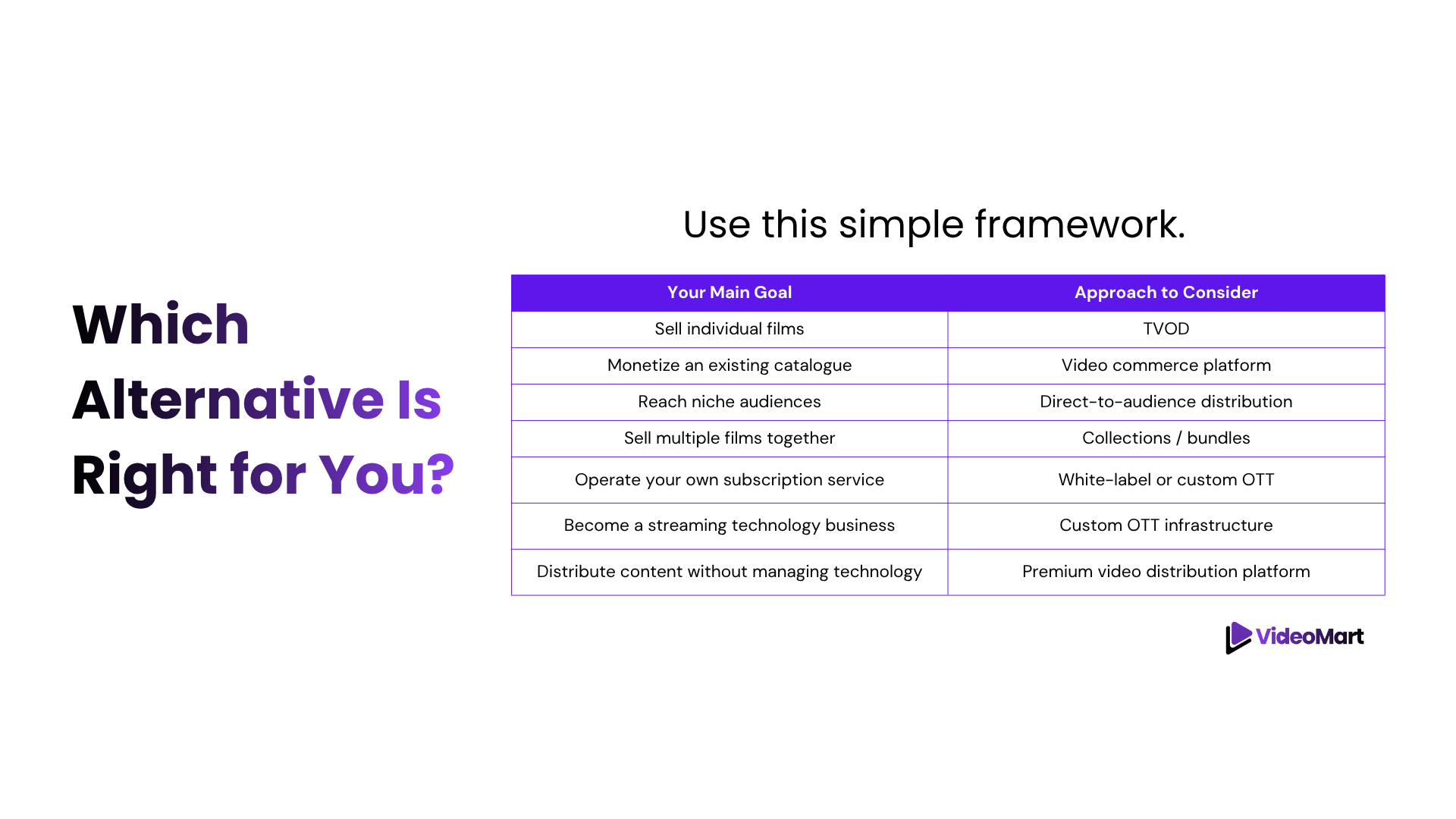
The important distinction is between wanting to distribute content and wanting to operate a streaming company.
Why VideoMart Fits the Distribution-First Model
VideoMart's product philosophy is built around making premium video content commercially accessible without requiring every creator or organization to become a technology company.
Its knowledge base positions VideoMart as the commerce layer for premium video experiences, with features including TVOD, video commerce, creator channels, secure distribution, analytics, built-in payments, search and discovery, and AI-assisted copyright protection.
For filmmakers and production houses, the practical implication is simple:
You can focus on making, owning, packaging, and promoting content while using existing infrastructure for distribution and monetization.
That is fundamentally different from building an OTT platform from the ground up.
When Should You Actually Build Your Own OTT?
There are legitimate reasons to build one.
Consider it when:
Streaming itself is your core business.
You have a substantial catalogue.
You expect a large recurring subscriber base.
You have dedicated technical resources.
You need extensive customization.
You want to control the complete product experience.
You're prepared for continuous technology investment.
In other words, build an OTT when the platform is part of the business you want to operate.
Don't build one simply because you have videos to sell.
Common Mistakes Content Owners Make
Mistake 1: Confusing Content Ownership With Technology Ownership
Owning your films doesn't mean you need to own the entire technology stack.
Mistake 2: Budgeting Only for Development
The cost of an OTT doesn't end when the first version launches.
Infrastructure, security, maintenance, updates, support, and marketing continue.
Mistake 3: Thinking Technology Creates Demand
A beautiful streaming app doesn't automatically create an audience.
Content quality, positioning, distribution, and marketing still matter.
Mistake 4: Building Before Validating Demand
If you don't yet know whether people will pay for your content, investing heavily in infrastructure can be premature.
Testing demand through an existing distribution model can provide useful market feedback first.
Frequently Asked Questions
What is the best alternative to building an OTT platform?
There isn't one universal answer. For filmmakers and production houses primarily interested in selling and distributing premium content, an existing video commerce or distribution platform can remove much of the technical complexity of building an OTT.
Can I sell my film without building an OTT platform?
Yes. TVOD and direct-to-audience video commerce allow viewers to purchase individual films without requiring the content owner to operate a complete streaming service.
Can a production house monetize an old film catalogue?
Yes. Existing films can be repackaged into individual products, collections, bundles, or premium digital releases.
Is a white-label OTT better than using a video distribution platform?
They solve different problems. A white-label OTT is relevant when you specifically want to operate a branded streaming service. A video distribution platform is more focused on helping you distribute and monetize content without managing the underlying streaming infrastructure.
Does using a distribution platform mean I don't need marketing?
No. Distribution infrastructure makes content available; it doesn't replace audience development. Filmmakers and production houses still need to promote their content and build demand.
Can VideoMart distribute films for production houses?
VideoMart's platform is designed to enable creators and organizations to upload, price, distribute, and monetize premium video experiences directly. Its entertainment mode specifically includes filmmakers and production houses as target categories.
Key Takeaways
You don't need to build an OTT platform simply because you own films.
Building a streaming company and distributing content are different business models.
TVOD allows individual films to be sold directly to viewers.
Existing film libraries can be turned into digital products and collections.
Premium video commerce platforms can provide distribution infrastructure without requiring content owners to build it themselves.
White-label OTT and custom OTT development remain options when operating a streaming service is itself the business objective.
Your technology choice should follow your business model—not the other way around.
Conclusion
The question isn't really:
"How do I build my own OTT platform?"
The better question is:
"What is the simplest way for me to get my content in front of paying audiences?"
If you're a filmmaker or production house, your biggest asset is probably your content.
That's where your time, creativity, and capital should go.
You may not need to build servers, streaming architecture, payment systems, security infrastructure, and applications just to sell a film.
You need a reliable distribution system that lets your content reach people who want to watch it.
For businesses whose primary goal is content distribution and monetization—not becoming a technology company—using existing premium video commerce infrastructure can be a fundamentally different path.
Make the content. Build the audience. Let the infrastructure handle itself.
Call to Action
Have films sitting on hard drives, waiting for distribution?
VideoMart provides a premium video commerce infrastructure that enables filmmakers and production houses to upload, price, distribute, and monetize their content directly—without requiring them to build an OTT platform from scratch.
Your next project doesn't have to begin with a technology build.
It can begin with your content.
.png)