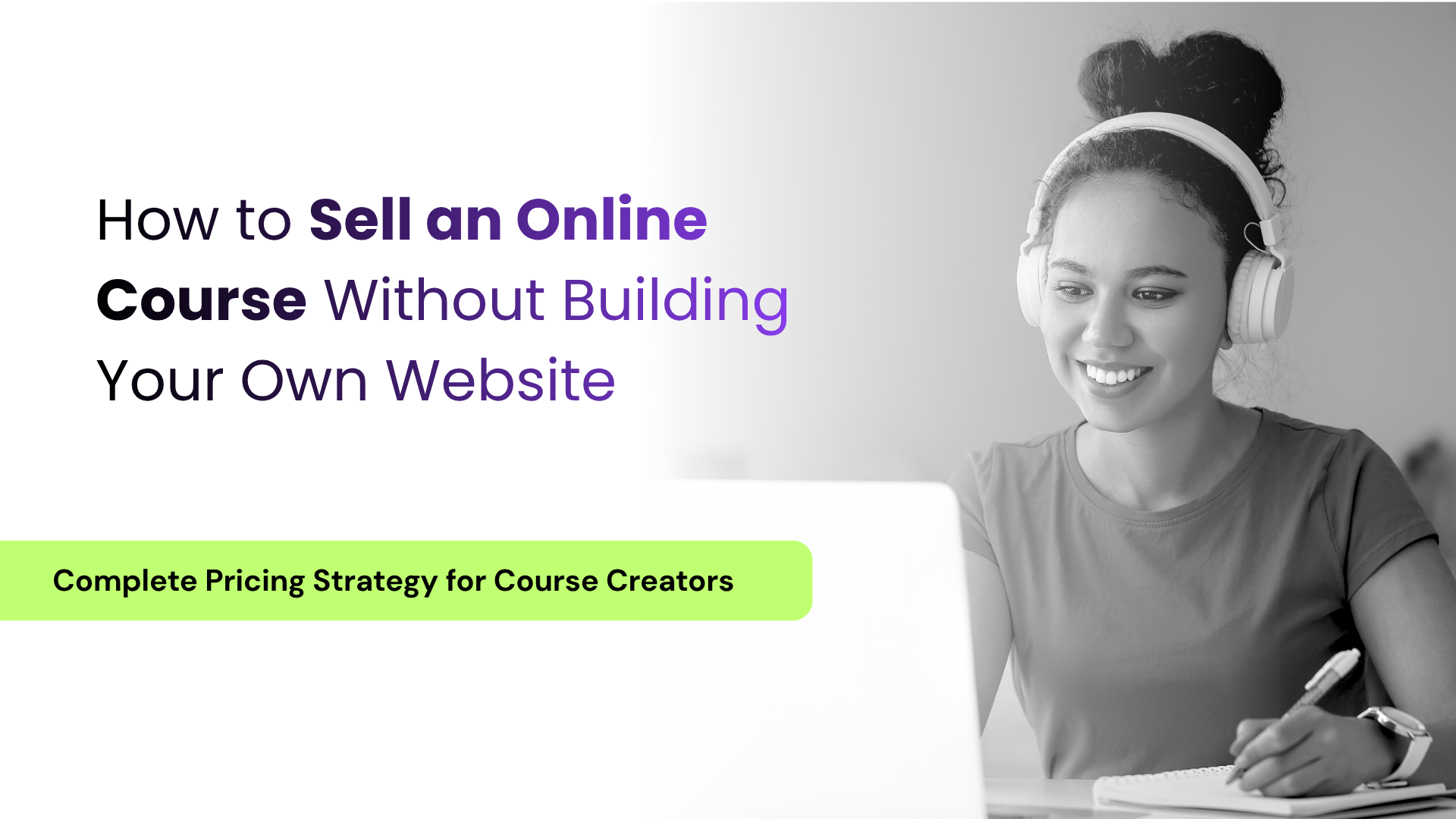
You don't need to spend weeks building a website before you can sell your first online course.
A website can eventually become an important marketing asset, but it isn't a prerequisite for validating a course idea, collecting payments, delivering lessons, or generating your first customers.
A course creator can combine social media, WhatsApp, payment links, landing pages, email, course-hosting platforms and automation to create a functioning sales system without owning a traditional website.
The important thing is to separate two things:
Having a website and having a sales system are not the same thing.
You can have a beautiful website with no customers.
You can also sell a course successfully with a very simple digital setup.
Can You Really Sell an Online Course Without a Website?
Yes.
A basic course-selling system can work like this:
Instagram/YouTube/LinkedIn → Course offer → Landing page or sales message → Payment → Course access
You can even simplify it further:
Social media → WhatsApp → Payment link → Course access
The technology can be relatively simple.
The harder part is creating an offer that people actually want to buy.
Why You Might Not Need a Website Initially
Building a website involves more than designing a few pages.
You may need:
Domain
Hosting
Website design
Payment integration
Course delivery
User accounts
Email automation
Analytics
Security
Maintenance
SEO
Conversion optimization
For a new course creator, investing heavily in infrastructure before validating demand can be unnecessary.
A simpler approach is:
Validate first. Build infrastructure later.
If you sell 20, 50 or 100 course seats through a simple funnel, you now have evidence that your offer has demand.
You can then invest in a more sophisticated website and learning platform.
1. Sell Your Course Through Social Media
Social media can function as your top-of-funnel sales channel.
Depending on your audience, you could use:
Instagram
Facebook
YouTube
LinkedIn
X
Telegram
WhatsApp
You don't need to create content that constantly says:
"Buy my course."
Instead, demonstrate your expertise.
For example, if you sell a digital marketing course, create content around:
Meta Ads mistakes
Google Ads tips
SEO techniques
AI marketing tools
Landing-page optimization
Marketing case studies
Business growth strategies
The content attracts the audience.
The course becomes the monetization layer.
2. Use a Payment Link Instead of a Website Checkout
One of the simplest ways to sell a course is through a payment link.
Instead of building a complete checkout system, you can create a payment page through a supported payment provider and share the link.
Your customer can receive the link through:
Instagram DM
WhatsApp
Email
YouTube description
LinkedIn
Telegram
Facebook
SMS
The basic process is:
Customer sees offer → clicks payment link → pays → receives course access
This removes a significant amount of technical work.
3. Sell Through WhatsApp
For many course creators, particularly those selling in India, WhatsApp can become an important part of the sales process.
You can create a WhatsApp funnel such as:
Instagram Reel → WhatsApp → Free resource/masterclass → Course offer → Payment → Course access
For higher-priced courses, WhatsApp can also support a more conversational sales process.
For example:
"What are you trying to learn?"
"Are you starting from zero?"
"Are you looking to get a job or grow your business?"
The answers can help determine whether the course is appropriate.
This is particularly useful for courses priced significantly higher than low-cost recorded products.
4. Use a Landing Page Instead of a Full Website
There is an important distinction between a website and a landing page.
A traditional website might contain:
Home
About
Services
Blog
Contact
Multiple product pages
A course landing page can contain one objective:
Get the visitor to enroll.
A basic course landing page might include:
Course headline
Clearly communicate the transformation.
Problem
Explain what the student currently struggles with.
Outcome
Explain what they will learn or be able to do.
Curriculum
Show the modules.
Instructor
Establish credibility.
Testimonials
Use genuine student feedback.
Pricing
Make the offer clear.
FAQ
Address objections.
CTA
Give the visitor an obvious next step.
You don't need a traditional website to create this type of sales page.
5. Sell Through an Existing Course Platform
Another option is to use a third-party course platform.
These platforms can provide some combination of:
Course hosting
Student accounts
Video delivery
Payments
Enrollment
Progress tracking
Certificates
Email notifications
Instead of building these systems yourself, you use existing infrastructure.
This can significantly reduce the technical complexity of launching a course.
The trade-off is that you may have less control over the customer experience, branding, fees or platform policies than you would with your own system.
6. Sell Through Marketplaces
Course marketplaces can provide another route to customers.
The marketplace handles some combination of:
Hosting
Payments
Discovery
Course delivery
Customer management
This can be useful if you don't have an existing audience.
However, marketplace distribution can also mean competing with many other instructors.
You may have less control over:
Pricing
Customer relationship
Branding
Promotions
Platform fees
Audience data
Therefore, marketplaces should be evaluated based on your business model rather than treated as automatically better than owning your customer relationship.
7. Run a Live Masterclass Before Selling the Full Course
This is one of the strongest ways to validate an online course without building a website.
Instead of immediately selling a ₹30,000 course, for example, you could first offer a focused live masterclass.
The funnel could look like:
Social media → ₹499/₹999 masterclass → Live session → Course offer
Or:
Free webinar → Course presentation → Enrollment
This approach lets you test:
Whether people care about the topic
Which problems they want solved
What questions they ask
Which objections stop them from buying
Whether they are willing to pay
Your masterclass can become a customer acquisition mechanism rather than simply a free educational session.
8. Use a Free Lead Magnet
Another option is to collect potential students before selling the course.
Create something genuinely useful:
Checklist
PDF guide
Mini-course
Template
Calculator
Webinar
Workshop
Resource library
Free lesson
Then promote it through social media.
For example:
Instagram Reel → Free Digital Marketing Checklist → WhatsApp/Email → Course Offer
This gives you an audience you can continue communicating with instead of relying entirely on algorithms.
9. Sell Through Email
You don't need a website to build an email list.
You can collect email addresses through:
Lead forms
Webinar registrations
Lead magnets
Course registrations
Events
Social media campaigns
Then create an email sequence.
For example:
Email 1: Deliver the free resource
Email 2: Explain the problem
Email 3: Teach something useful
Email 4: Show a common mistake
Email 5: Introduce your course
Email 6: Explain the curriculum
Email 7: Address objections
Email 8: Enrollment reminder
The goal isn't to bombard people with promotional messages.
The goal is to gradually move them from awareness → trust → consideration → purchase.
10. Use YouTube as Your Course Funnel
YouTube can be particularly powerful for educational products because people are already searching for answers.
Suppose you sell a course about starting an online business.
You could create videos such as:
How to start an online business
How to find a profitable niche
How to create a digital product
How to run Meta Ads
How to build a sales funnel
Then include a relevant CTA.
For example:
"If you want the complete step-by-step system, join my full program."
This turns free educational content into a customer acquisition channel.
11. Use Instagram Reels for Discovery
Short-form video is useful for generating awareness.
But don't make every Reel promotional.
Use different content categories.
Educational
Teach something.
Problem-focused
Highlight a problem your target audience experiences.
Proof
Show genuine results, student feedback or work.
Authority
Demonstrate your knowledge.
Personal
Show the person behind the course.
Promotional
Present the actual course offer.
A healthy content system gives the audience reasons to follow you before asking them to buy.
12. Use LinkedIn for Professional Courses
If your course is about:
Marketing
Sales
AI
Business
Leadership
Technology
Career development
Consulting
Professional skills
LinkedIn can be particularly relevant.
Instead of publishing generic promotional posts, share practical insights.
For example:
"I audited 50 landing pages. Here are the five mistakes I found repeatedly."
The content establishes expertise.
Then the course becomes the deeper learning product.
13. Use a Simple No-Website Course Funnel
A very simple setup could look like this:
Instagram / YouTube / LinkedIn
↓
Free content
↓
WhatsApp or email
↓
Free workshop / masterclass
↓
Course offer
↓
Payment link
↓
Course platform
↓
Student onboarding
You don't need a traditional website anywhere in this funnel.
14. What You Actually Need
If you're launching your first course, your technology stack can be surprisingly small.
You may need:
1. Content platform
Instagram, YouTube, LinkedIn or another channel.
2. Communication channel
WhatsApp or email.
3. Payment system
A payment link or checkout solution.
4. Course delivery
A course-hosting platform or learning environment.
5. Content
Your actual course lessons.
6. Sales mechanism
A landing page, masterclass, webinar or direct sales conversation.
That's enough to start.
15. Don't Confuse Course Delivery With Course Marketing
This distinction is critical.
A course platform helps students consume your course.
It doesn't necessarily bring you students.
Similarly, a payment gateway helps you collect money.
It doesn't necessarily generate sales.
Your marketing system is responsible for creating demand.
Think about your business as four separate components:
Traffic → Conversion → Payment → Delivery
You can solve each component independently.
16. How to Sell a High-Ticket Course Without a Website
If your course costs ₹20,000, ₹50,000 or ₹1 lakh+, the sales process may need more than a payment button.
A potential funnel could be:
Content → Lead magnet → WhatsApp → Qualification → Discovery call → Course presentation → Payment → Onboarding
Or:
Content → Free masterclass → Application → Sales conversation → Enrollment
For high-ticket education products, trust and perceived value become extremely important.
Your prospects may want to know:
Who is teaching?
What exactly will I learn?
Is it live or recorded?
How much support do I receive?
Who is this designed for?
What happens after I enroll?
What proof exists that the program delivers what it promises?
A website can help communicate these things, but it isn't the only way.
17. How to Sell a Low-Ticket Course Without a Website
For a ₹299–₹2,999 product, the funnel can be much shorter.
For example:
Instagram Reel → Course page → Payment → Instant access
Or:
YouTube video → Course link → Payment → Access
The lower the price and the stronger the trust, the less complicated the buying journey can be.
18. When Should You Actually Build a Website?
You don't necessarily need one on day one.
A website becomes increasingly valuable when you need:
SEO traffic
Multiple courses
Strong brand positioning
Content marketing
Blog traffic
Multiple instructors
Corporate training
Affiliate programs
Automated funnels
Retargeting
Advanced analytics
Better customer ownership
Long-term brand building
At that point, your website becomes more than a digital brochure.
It becomes an owned acquisition and conversion asset.
19. The Biggest Mistake: Building Before Selling
Many new course creators spend months working on:
Logo
Website
Fonts
Brand colors
Course platform
Automation
Videos
Presentation templates
And then discover that nobody wants to buy the course.
Reverse the process.
Start with:
Problem → Audience → Offer → Validation → Sales → Delivery → Optimization → Infrastructure
You don't need perfect technology to test demand.
You need a compelling offer and access to potential customers.
20. A Practical No-Website Course Launch Plan
Week 1: Define the offer
Determine:
Target audience
Problem
Desired outcome
Course format
Curriculum
Price
Guarantee/refund policy where appropriate
Week 2: Create the sales mechanism
Set up:
Payment system
Course delivery
WhatsApp/email process
Landing page or sales document
Enrollment process
Week 3: Start audience building
Publish useful content.
Talk about the problem.
Collect leads.
Invite prospects to a webinar or masterclass.
Week 4: Sell
Run your masterclass or launch campaign.
Answer questions.
Handle objections.
Close enrollments.
Then improve the system based on actual customer behavior.
Can You Build a ₹1 Lakh+ Course Business Without a Website?
Yes, technically.
But the question is not whether it is possible.
The more important question is whether your customer acquisition system is strong enough.
A high-ticket course requires:
Audience + Authority + Trust + Strong Offer + Sales Process + Delivery
A website can support these things.
It cannot replace them.
Final Takeaway
You don't need to build a website before selling your first online course.
You can start with:
Social media → Content → WhatsApp/email → Masterclass or landing page → Payment link → Course platform
Once you prove that people are willing to pay, you can invest in a larger ecosystem.
The goal shouldn't be:
"How do I build a website?"
The better question is:
"What is the simplest system I can build that takes a stranger from discovering my expertise to becoming a paying student?"
Start there.
Build the website when it becomes a business requirement—not because every course creator is expected to have one.
.png)