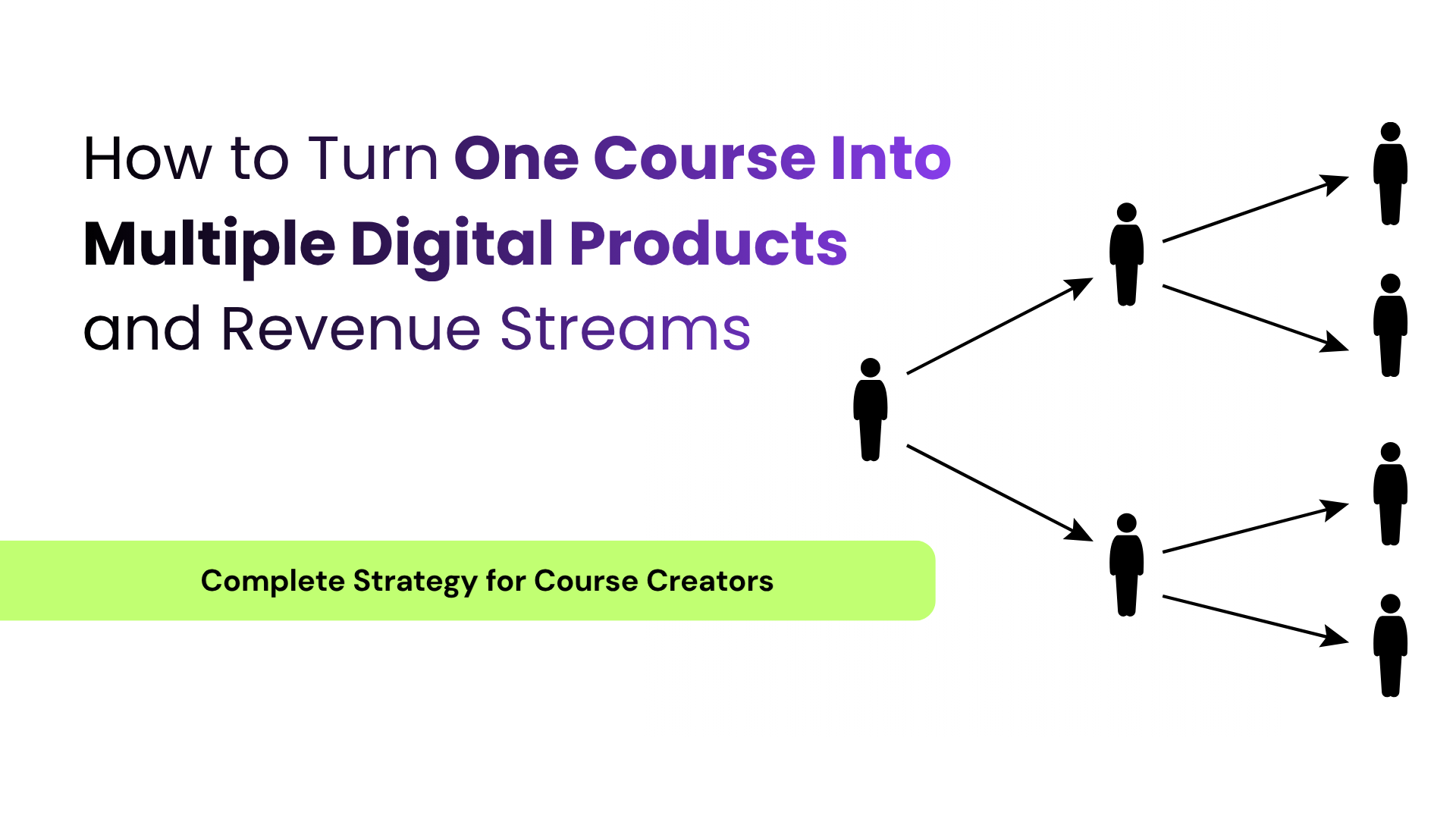
How to Turn One Course Into Multiple Digital Products and Revenue Streams
Creating a high-quality online course takes significant work.
You research the subject, structure the curriculum, create lessons, record videos, prepare resources, build presentations, answer questions and develop supporting materials.
The mistake is using all that work only once.
A well-designed course can become the core intellectual property of an entire digital product business.
One course can potentially be transformed into:
A short workshop
An ebook
A practical guide
Templates
Checklists
Prompt packs
A recorded mini-course
A live masterclass
A membership
A community
A certification program
Consulting
Coaching
Corporate training
Licensing
An advanced course
A subscription product
The objective isn't to create 15 unrelated products.
The objective is to repurpose the same expertise for different customer needs, price points and buying situations.
The Core Idea: One Knowledge Asset, Multiple Products
Think of your course as a knowledge library.
Suppose you have a course called:
"AI-Powered Digital Marketing."
It might contain 10 major modules.
Each module contains lessons.
Each lesson contains frameworks, examples, checklists, templates and practical exercises.
Instead of treating the course as one product, think of it as:
Core expertise → Multiple assets → Multiple offers → Multiple revenue streams
This increases the commercial value of the work you've already created.
Why Course Creators Should Build Multiple Revenue Streams
Relying on one course creates several problems.
If sales decline, your entire revenue can decline.
If the course appeals only to beginners, you have limited monetization opportunities.
If someone isn't ready to buy your full course, you have nowhere else to send them.
A product ecosystem solves this.
You can have:
Free content
↓
Low-ticket product
↓
Core course
↓
Advanced program
↓
Membership
↓
Consulting
↓
Corporate training
The customer can enter at different points depending on their needs and budget.
Step 1: Break Your Course Into Knowledge Assets
Start by dissecting your existing course.
List:
Modules
Lessons
Frameworks
Checklists
Templates
Exercises
Case studies
Examples
Worksheets
Scripts
Prompts
FAQs
Common mistakes
Student questions
Don't think about products yet.
First identify everything you've already created.
You will probably discover that your course contains far more reusable intellectual property than you initially realized.
Step 2: Turn the Course Into an Ebook
An ebook is one of the easiest products to create from an existing course.
Your course modules can become chapters.
For example:
Course
"How to Build an Online Business"
could become:
Ebook
"How to Start an Online Business: A Practical Beginner's Guide"
But don't simply export your video transcripts.
Rewrite the material for reading.
Add:
Examples
Frameworks
Diagrams
Checklists
Action steps
Worksheets
The ebook can become a standalone product or a bonus for your main course.
Step 3: Create a Short Version of the Course
Your complete course may be too extensive for some customers.
Create a smaller version.
For example:
Full course: 40 hours
Mini-course: 3 hours
The mini-course should solve a narrower problem.
For example:
Full:
"Complete Digital Marketing Program"
Mini-course:
"How to Generate Your First 100 Leads With Meta Ads"
This creates a lower-friction entry point.
Step 4: Turn Your Frameworks Into Templates
Templates can become highly valuable digital products because customers don't just want knowledge.
They want shortcuts.
If your course contains:
Marketing plans
Content calendars
Ad structures
Business plans
Sales scripts
Prompt frameworks
Campaign templates
Spreadsheet models
Checklists
turn them into standalone products.
For example:
Course lesson:
"How to create a content strategy."
Digital product:
"90-Day Content Strategy Template."
The second product solves the implementation problem.
Step 5: Create a Toolkit
Combine multiple small assets into one package.
For example:
Digital Marketing Toolkit
could contain:
Content calendar
Campaign planner
Ad copy templates
SEO checklist
Landing-page checklist
AI prompts
Marketing KPI tracker
Competitor research template
The individual components might have limited value on their own.
Together, they become a stronger product.
Step 6: Create a Prompt Pack
If your course teaches AI, this can be particularly useful.
Extract the prompts you already teach.
Organize them by use case:
Research
Content creation
SEO
Advertising
Sales
Customer service
Business planning
Analysis
Automation
Don't simply sell a random list of prompts.
Explain:
When to use it → What to provide → Prompt → Expected output → How to improve it
The methodology can be more valuable than the prompt itself.
Step 7: Turn the Course Into a Live Masterclass
Your recorded course can become the foundation for a live experience.
Instead of selling:
"30 hours of training."
offer:
"3-hour live intensive."
The live format can focus on one transformation.
For example:
"Build Your First Online Business in 3 Hours."
The masterclass can then become an acquisition channel for your larger course.
This creates a powerful funnel:
Free content → Paid masterclass → Full course
Step 8: Create Workshops From Individual Modules
Your course modules can become standalone workshops.
Suppose your course contains:
Business model
Branding
Website
Marketing
Advertising
Automation
You could turn them into six workshops.
For example:
Build Your Online Business Model
Create Your First Conversion-Focused Website
Launch Your First Meta Ads Campaign
Build Your AI Automation System
Each workshop can be sold individually or bundled.
Step 9: Create a Certification Program
If your subject is suitable for assessment-based learning, you can create a certification layer.
The certification could include:
Course completion
Assessment
Practical assignment
Project submission
Evaluation
Certificate
This can increase perceived structure and provide students with a tangible completion credential.
However, be careful with terminology.
Don't imply that your certificate is an officially recognized professional qualification unless it genuinely is.
Step 10: Build a Paid Community
Your course can become the entry point to a community.
The community could provide:
Q&A
Peer networking
New resources
Monthly sessions
Expert sessions
Industry updates
Accountability
Job opportunities where appropriate
Collaboration opportunities
The key advantage is that the community can generate recurring revenue rather than only one-time course sales.
For example:
Course → Community → Monthly subscription
The community should provide ongoing value rather than simply being a chat group.
Step 11: Create a Membership
If your subject changes frequently, a membership can work particularly well.
For example:
AI Marketing Membership
Members receive:
New tutorials
Monthly workshops
New prompts
Templates
Tool updates
Q&A sessions
Community access
Instead of selling the same course repeatedly, you're selling continuing access to updated expertise.
Step 12: Turn Your Expertise Into Consulting
Some students don't want to learn everything themselves.
They want someone to help them implement it.
That's where consulting comes in.
Your course teaches:
"How to build a digital marketing strategy."
Your consulting offer provides:
"We'll build your digital marketing strategy with you."
The knowledge is similar.
The delivery mechanism is different.
This creates a significant opportunity for higher-value customers.
Step 13: Create a Coaching Program
Coaching sits between education and consulting.
You teach the framework while helping the customer apply it.
For example:
Course: Learn how to build an online business.
Coaching: Six-week Online Business Accelerator.
The coaching program could include:
Weekly calls
Assignments
Reviews
Feedback
Accountability
Community
The customer isn't just buying information.
They're buying guidance and accountability.
Step 14: Sell Corporate Training
Your course can become a B2B product.
Instead of selling one course seat to one individual, package the content for organizations.
For example:
Consumer product:
"AI Marketing Mastery"
Corporate product:
"AI Productivity Program for Marketing Teams"
You can offer:
Bulk licenses
Live workshops
Cohort training
Assessments
Certificates
Completion reports
Custom examples
Corporate support
This can create an entirely separate revenue channel.
Step 15: License Your Content
Licensing allows another organization to use your educational content under defined terms.
Potential licensees could include:
Training institutes
Colleges
Coaching centers
Corporate academies
Educational companies
Professional associations
Instead of selling one student enrollment, you negotiate access for an organization.
Licensing terms should clearly define:
Duration
Number of users
Content usage
Branding
Modification rights
Distribution rights
Geographic scope
Renewal
Protect your intellectual property with appropriate agreements.
Step 16: Create an Advanced Course
Your first course shouldn't necessarily be the end of the customer journey.
Create a progression.
For example:
Beginner → Intermediate → Advanced
A student who completes the beginner course becomes a potential customer for the advanced program.
This increases customer lifetime value.
For example:
Course 1: Digital Marketing Fundamentals
↓
Course 2: Performance Marketing
↓
Course 3: AI Marketing Automation
↓
Course 4: Marketing Growth Accelerator
The customer doesn't have to leave your ecosystem to continue learning.
Step 17: Create a Product Ladder
Instead of thinking about individual products, build a product ladder.
A possible structure:
Free
YouTube videos
Blog posts
Social content
Free guides
Low Ticket
Templates
Checklists
Prompt packs
Short workshops
Core
Full online course
Mid Ticket
Coaching
Cohort program
Certification
High Ticket
Consulting
Done-with-you implementation
Corporate training
Recurring
Membership
Community
Subscription
This gives different customers different ways to buy from you.
Step 18: Turn Your Course Into Content
Your course itself can become a content engine.
One module can generate:
Blog articles
YouTube videos
Instagram Reels
LinkedIn posts
Carousels
Podcasts
Email newsletters
Checklists
Case studies
Short tutorials
For example:
One course module
↓
5 YouTube videos
↓
10 short-form videos
↓
3 blog articles
↓
5 LinkedIn posts
↓
1 downloadable guide
↓
1 webinar
The key is to extract ideas rather than simply copying the same material everywhere.
Step 19: Use Free Content to Sell Paid Products
Not every piece of your course needs to be paid.
Give away enough useful information to demonstrate your expertise.
Then position your paid products around:
Depth
Structure
Implementation
Support
Templates
Feedback
Accountability
Community
This creates a natural difference between free content and paid education.
Step 20: Build a Revenue Flywheel
Your products should feed each other.
A possible system is:
Free content
↓
Low-ticket product
↓
Core course
↓
Advanced program
↓
Consulting
↓
Corporate training
↓
Membership
↓
Referrals
A customer may not follow this exact path.
But the ecosystem gives you more opportunities to monetize the same relationship.
Example: Turning One Digital Marketing Course Into 10 Products
Imagine your original course is:
Complete Digital Marketing Mastery
You could potentially transform it into:
Digital Marketing Beginner's Guide
SEO Checklist
Meta Ads Template Pack
AI Marketing Prompt Pack
Digital Marketing Masterclass
Complete Digital Marketing Course
Advanced Performance Marketing Program
Digital Marketing Certification
Marketing Community
Corporate Digital Marketing Training
The underlying expertise remains largely the same.
What changes is the format, depth, audience, implementation support and price.
Don't Create Products Just for the Sake of Creating Products
This is where many creators go wrong.
Having 20 products doesn't automatically create a better business.
Every product should solve a specific problem.
Ask:
Who is this for?
What problem does it solve?
Why would someone buy this instead of the main course?
Where does it sit in the customer journey?
Can it lead naturally to another product?
If you can't answer those questions, you probably don't need the product.
The 80/20 Approach to Course Monetization
You don't need to build everything at once.
Start with three layers.
Layer 1: Acquisition
Create free content that attracts your target audience.
Layer 2: Core Product
Sell your main course.
Layer 3: Expansion
Add one higher-value product and one recurring product.
For example:
Free content → Course → Coaching
and
Course → Membership
Once those work, add corporate training, licensing or additional products.
How to Decide Which Product to Create Next
Look at what your customers repeatedly ask for.
If students say:
"Can you give me a template?"
Create templates.
If they say:
"Can you personally review my work?"
Create coaching or consulting.
If they say:
"Can you train my team?"
Create corporate training.
If they say:
"Can we get monthly updates?"
Create a membership.
Your customers are effectively telling you what your next product should be.
Protect Your Intellectual Property
As your product ecosystem grows, protect the underlying assets.
Consider:
Copyright ownership
Licensing agreements
Terms of use
Course access restrictions
Corporate licensing terms
Contractor agreements
Content usage policies
Trademark protection where appropriate
Don't assume that uploading your course online automatically gives you complete commercial protection.
For substantial licensing or corporate arrangements, use appropriate legal agreements.
Measure Revenue Per Customer, Not Just Course Sales
Suppose you sell 1,000 courses at ₹5,000.
That's ₹50 lakh in course revenue.
But imagine some of those customers also purchase:
₹2,000 toolkit
₹10,000 advanced program
₹20,000 coaching
₹1,000/month membership
Your original course becomes the beginning of the customer relationship rather than the end.
This is where a digital product ecosystem can become much more powerful than a single-course business.
Common Mistakes When Repurposing a Course
Creating Too Many Products
More products can create more complexity.
Making Every Product Identical
A PDF version of your course isn't necessarily a compelling standalone product.
Ignoring Customer Needs
Build products based on real demand.
Underpricing High-Value Implementation
Information and implementation have different perceived value.
Forgetting Recurring Revenue
A one-time purchase ends the transaction. Memberships and subscriptions can create ongoing relationships when they genuinely provide continuing value.
Focusing Only on New Customers
Existing students already understand your expertise.
They may be your easiest audience for advanced products.
A Practical Course Monetization Roadmap
Start with your existing course.
Stage 1
Create:
Free content + Core course
Stage 2
Add:
Templates + Workshop
Stage 3
Add:
Advanced program + Coaching
Stage 4
Add:
Membership + Community
Stage 5
Add:
Corporate training + Licensing
You don't need to launch all five stages simultaneously.
Build each layer after validating demand.
The Most Important Concept: Repurpose the Knowledge, Not the Product
Your objective isn't to sell the same course in 15 different formats.
Your objective is to take the same underlying expertise and solve different customer problems.
A beginner might want:
Information.
A business owner might want:
Implementation.
A corporate buyer might want:
Employee capability.
An advanced student might want:
Certification and specialization.
A returning customer might want:
Ongoing updates and support.
One knowledge base can serve all of these needs.
Final Takeaway
A successful online course doesn't have to be a single product.
It can become the foundation of an entire digital education business.
Start with one strong course.
Then extract its:
Knowledge → Frameworks → Templates → Content → Workshops → Community → Coaching → Consulting → Corporate training → Licensing
The smartest approach isn't to create more products simply because you can.
It's to build a product ecosystem where each offer has a clear purpose.
Your free content attracts attention.
Your low-ticket products create entry points.
Your core course generates the main transaction.
Your advanced programs increase customer value.
Your coaching and consulting monetize implementation.
Your corporate programs open B2B revenue.
Your membership creates recurring revenue.
Your licensing allows the same intellectual property to reach larger audiences.
The ultimate goal is simple:
Don't build one course business. Build a digital knowledge business around your course.
Once the core expertise is valuable, the same intellectual property can generate revenue in many different formats without requiring you to start from zero every time.
Frequently Asked Questions
Can one online course really become multiple products?
Yes. A comprehensive course often contains many reusable assets such as frameworks, templates, lessons, exercises, checklists and expertise that can be packaged into different products.
What digital products can I create from an online course?
Common options include ebooks, templates, checklists, prompt packs, workshops, mini-courses, memberships, communities, certification programs and toolkits.
Can I turn my course into a coaching program?
Yes. The course can provide the educational foundation while coaching adds accountability, personalized feedback and implementation support.
How can I turn an online course into corporate training?
Identify the organizational problem your course addresses and repackage the content around employee outcomes. Corporate offerings can include bulk licenses, live training, assessments, reporting, certificates and customization.
Is it better to sell one course or multiple products?
It depends on your business stage. One strong core product is generally easier to manage initially. Additional products should be introduced when they solve a genuine customer need or create a logical next step.
How can I create recurring revenue from an online course?
Memberships, communities, subscriptions, ongoing workshops and continuing education programs can create recurring revenue when they provide ongoing value beyond the original course.
Should I create a cheaper version of my main course?
A shorter or narrower product can work as an entry-level offer, provided it solves a specific problem rather than simply removing random sections from the main course.
How do I decide what product to create next?
Look at customer questions, objections, support requests and buying behavior. Repeated requests for templates, implementation help, advanced education or ongoing updates can reveal strong product opportunities.
Can I sell the same course to individuals and companies?
Yes, but the packaging may need to change. Individual buyers may purchase personal access, while companies may require bulk licensing, reporting, support, customization and formal procurement.
Does creating multiple revenue streams mean I need to create everything myself?
No. Once your business grows, some content production, customer support, marketing, technology and delivery can be delegated or automated. The core intellectual property and quality standards should remain under appropriate control.
Suggested
How to Sell Online Courses in India (2026 Guide for Educators, Coaches & Trainers)
How Coaches and Trainers Can Launch Their First Online Course Successfully
Build Passive Income by Selling Premium Video Courses Online
Video Commerce for Educators: The Future of Selling Knowledge Online
How AI Is Helping Educators Create and Sell Courses Faster Than Ever

.png)