If you've searched for "How much does it cost to build an OTT platform?", you've probably seen estimates ranging from ₹10 lakh to over ₹5 crore.
So, which one is correct?
The answer is: it depends on what you're trying to build.
Many creators, educators, production houses, and media businesses believe they need an OTT platform. In reality, what they often need is a reliable way to sell premium video content, manage customers, and generate recurring revenue.
That's an important distinction.
According to Statista Market Insights, India's OTT video market is projected to generate approximately ₹458.85 billion in revenue in 2026 and is expected to grow to ₹634.34 billion by 2030, with more than 662 million users projected by the end of the decade. As demand for premium digital content grows, businesses are increasingly looking beyond YouTube and traditional broadcasters to build direct-to-consumer video businesses.
But before investing lakhs—or even crores—into custom development, you should understand what you're actually paying for.
This guide breaks down the real cost of building an OTT platform, highlights the hidden expenses most businesses overlook, and explains why many companies are now evaluating video commerce platforms instead of building everything from scratch.
What Does Building an OTT Platform Actually Mean?
An OTT platform is much more than a website that streams videos.
A production-ready platform typically includes:
Website
Android app
iOS app
Smart TV apps
Video hosting
Cloud infrastructure
Content Delivery Network (CDN)
Digital Rights Management (DRM)
Payment gateway integration
User authentication
Search engine
Recommendation system
Analytics dashboard
Content Management System (CMS)
Admin panel
Notifications
Customer support tools
Each of these components requires development, testing, maintenance, and ongoing investment.
That's why building an OTT platform is closer to building a technology company than launching a simple streaming website.
What Are You Actually Trying to Build?
Before discussing costs, ask yourself one question:
Are you trying to build streaming software, or are you trying to build a profitable video business?
Most businesses don't care about servers, APIs, or CDNs.
They care about:
Selling premium videos
Controlling pricing
Protecting copyrighted content
Owning customer relationships
Receiving payments
Growing revenue
These are commerce problems, not streaming problems.
That's why a growing number of creators are shifting their focus from OTT platforms to video commerce platforms—solutions designed to simplify monetization rather than software development.
OTT Platform Development Cost Breakdown
1. Product Discovery & Planning
Every successful platform starts with strategy.
This phase includes:
Market research
Business model planning
Technical architecture
Feature prioritization
User journey mapping
Estimated Cost: ₹3 lakh – ₹10 lakh
Skipping this stage often leads to expensive redesigns later.
2. UI/UX Design
An intuitive interface improves user retention and engagement.
You'll need separate designs for:
Website
Mobile apps
Smart TVs
Creator dashboard
Admin panel
Estimated Cost: ₹2 lakh – ₹8 lakh
3. Backend Development
The backend powers everything users don't see:
Authentication
Video library
Payment processing
APIs
Analytics
Notifications
Admin tools
Estimated Cost: ₹8 lakh – ₹30 lakh
Platforms supporting multiple creators require significantly more complex backend systems than single-brand streaming apps.
4. Website Development
Your web platform includes:
Homepage
Search
Categories
Video player
Checkout
User profiles
Purchased library
Estimated Cost: ₹5 lakh – ₹15 lakh
5. Mobile Applications
Android App
Estimated Cost: ₹5 lakh – ₹15 lakh
iOS App
Estimated Cost: ₹6 lakh – ₹18 lakh
Both apps require ongoing updates as operating systems evolve.
6. Smart TV Applications
Premium video audiences increasingly consume content on television.
If you want maximum reach, you'll likely need applications for:
Android TV
Apple TV
Amazon Fire TV
Samsung Tizen
LG webOS
Estimated Cost: ₹4 lakh – ₹12 lakh per platform
7. Cloud Infrastructure
Streaming video requires robust cloud infrastructure for:
Storage
Transcoding
Databases
Auto scaling
Backup
Most OTT businesses use AWS, Google Cloud, or Microsoft Azure.
Monthly Cost: ₹30,000 – ₹5 lakh+
8. Content Delivery Network (CDN)
A CDN ensures fast video delivery across different locations.
Without it, users experience buffering, slower playback, and poor viewing experiences.
Monthly Cost: ₹25,000 – ₹4 lakh+
As viewership grows, CDN costs often become one of the largest operational expenses.
9. Digital Rights Management (DRM)
Premium content needs protection.
DRM helps prevent:
Illegal downloads
Screen recording
Unauthorized sharing
VideoMart also considers DRM, secure distribution, and AI-powered copyright protection essential to protecting creators and premium video businesses.
Estimated Cost: ₹2 lakh – ₹10 lakh
10. Payment Infrastructure
Selling videos requires more than accepting online payments.
You'll need:
UPI
Cards
Wallets
GST support
Refund management
Revenue reports
Creator payouts
VideoMart's creator-first approach focuses on enabling direct monetization with integrated payments and regular payouts, reducing the complexity creators face when selling premium content.
Estimated Cost: ₹2 lakh – ₹8 lakh
Total Development Cost
Platform TypeEstimated InvestmentBasic MVP₹20 lakh – ₹40 lakhMid-Scale OTT Platform₹40 lakh – ₹1.2 croreEnterprise OTT Platform₹1.5 crore – ₹5 crore+
These figures exclude marketing, content licensing, and recurring operational costs.
Hidden Costs Most Businesses Miss
Development is only the beginning.
After launch, you'll continue spending on:
Cloud hosting
CDN bandwidth
Software maintenance
Security monitoring
Customer support
Marketing
Feature development
Maintenance alone typically costs 15–20% of the original development budget each year.
Many first-time founders underestimate these recurring expenses.
Build Your Own OTT Platform or Use a Video Commerce Platform?
This is where many businesses make an expensive mistake.
Instead of asking:
"Can we build an OTT platform?"
Ask:
"Should we build one?"
Here's a practical comparison.
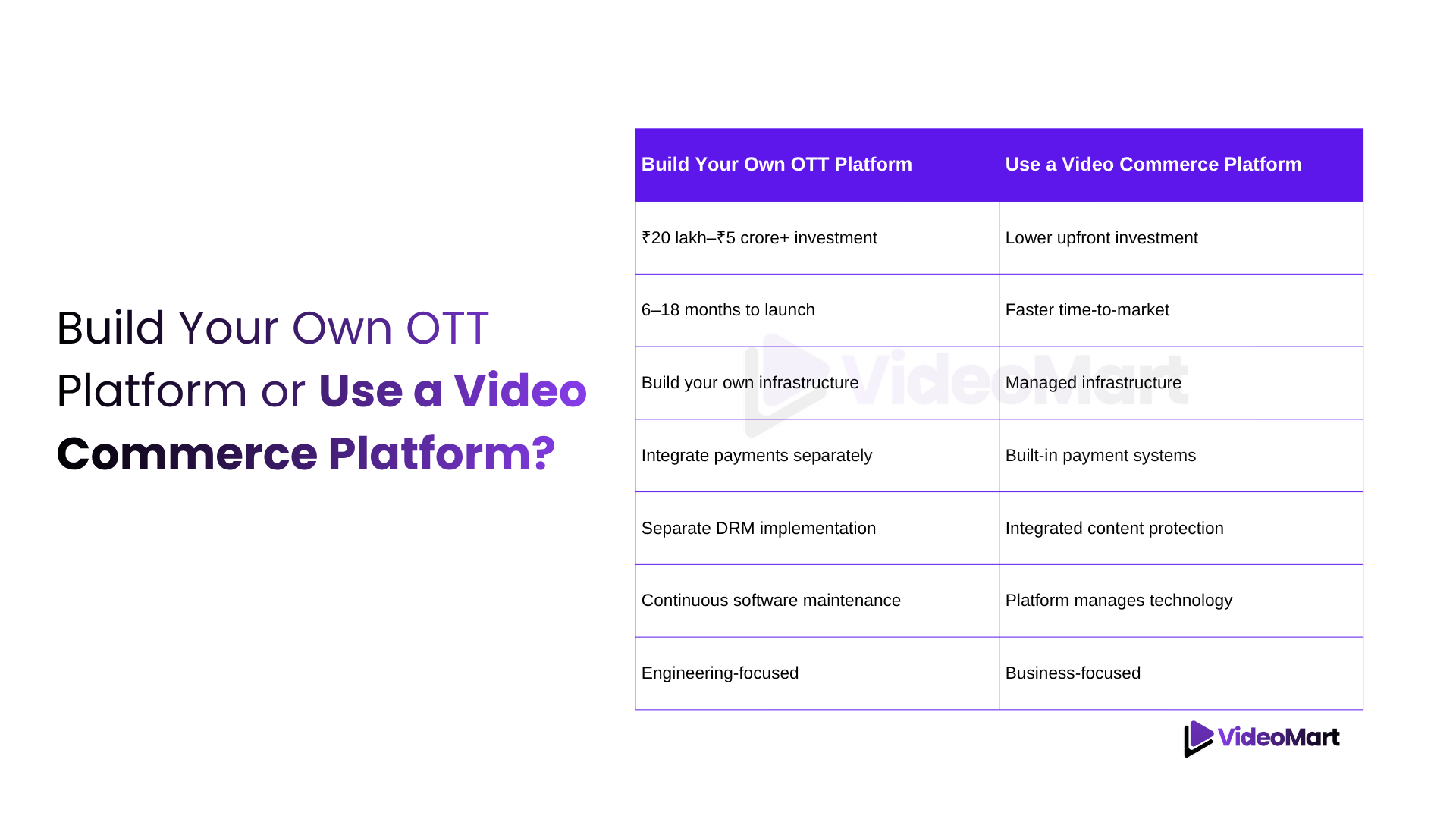
For large broadcasters and enterprise media companies, building custom infrastructure may be justified.
For creators, educators, filmmakers, production houses, and businesses, however, the priority is usually selling content—not managing software.
That's why a new category of video commerce platforms is gaining attention.
Instead of simply streaming content, these platforms combine hosting, secure delivery, payments, analytics, and monetization into one ecosystem.
VideoMart follows this philosophy by positioning itself as a premium video commerce ecosystem, helping creators upload, price, distribute, and monetize premium video experiences directly rather than functioning solely as a traditional OTT platform. Its core belief is simple: videos are products, creators are merchants, and audiences are customers.
Expert Insight
The biggest mistake businesses make is assuming that owning software automatically means owning a successful business.
It doesn't.
A profitable video business depends on:
Valuable content
Strong customer relationships
Effective pricing
Reliable monetization
Content protection
Technology should support those goals—not become the goal itself.
Frequently Asked Questions
How much does it cost to build an OTT platform in India?
A realistic investment ranges from ₹20 lakh for a basic MVP to over ₹5 crore for an enterprise-grade OTT platform, depending on complexity and scale.
What are the biggest recurring costs?
Cloud hosting, CDN bandwidth, software maintenance, security, customer support, and marketing are usually the largest ongoing expenses.
Is building an OTT platform worth it?
For broadcasters and large enterprises with unique technical requirements, yes. For many creators and growing businesses, using a video commerce platform often provides a faster and more cost-effective path to market.
What's the difference between an OTT platform and a video commerce platform?
An OTT platform focuses primarily on streaming. A video commerce platform combines streaming with payments, content monetization, audience management, and creator tools, enabling businesses to sell premium video experiences more efficiently.
Key Takeaways
Building an OTT platform requires significant upfront and ongoing investment.
Development costs are only one part of the total cost of ownership.
Cloud infrastructure, CDN, DRM, and maintenance create substantial recurring expenses.
Before investing in custom software, evaluate whether your real objective is streaming—or monetization.
For many creators and businesses, video commerce platforms provide a faster, lower-risk path to launching and growing a premium video business.
Conclusion
India's OTT industry continues to grow rapidly, creating exciting opportunities for creators, educators, production houses, and media companies. But success in 2027 won't depend on who builds the most complex streaming platform—it will depend on who builds the most sustainable business.
Before investing crores in custom development, ask yourself one final question:
Do you want to build streaming technology, or do you want to build a profitable video business?
If your goal is to monetize premium content, reach audiences faster, and focus on creating value instead of managing infrastructure, exploring a video commerce platform may be a smarter first step than building an OTT platform from scratch.
.png)