.png)
Making a film is difficult.
Finding an audience is another challenge. Turning that audience into sustainable revenue can be harder still.
Traditional distribution can involve gatekeepers, negotiations, territorial restrictions, and limited control over how audiences discover or pay for your work.
VideoMart is built around a different idea:
Your film can be treated as a product. You can decide what it is worth, make it available to an audience, and build a direct commercial relationship around it.
VideoMart describes itself as a premium video marketplace and video commerce platform. Its core thesis is straightforward: videos are products, creators are merchants, and audiences are customers.
For filmmakers, that means the platform is designed around direct distribution and monetization rather than simply giving a film another place to stream.
What Is VideoMart for Filmmakers?
VideoMart's Entertainment Mode is designed for filmmakers, production houses, studios, web-series creators, micro-drama creators, musicians, performers, sports organizations, regional entertainment creators, event organizers, AI filmmakers, animation creators, and other premium entertainment producers.
For filmmakers specifically, the platform is intended to support the journey from:
Film → Product → Audience → Purchase → Revenue
The platform's stated mission is to enable creators to upload, price, and monetize premium videos directly.
That makes VideoMart relevant for filmmakers who want an online distribution option where monetization is part of the product experience—not something dependent entirely on advertising or algorithmic reach.
Why VideoMart Was Built
VideoMart's internal documentation identifies several problems affecting creators:
Limited direct monetization
Dependence on algorithms
OTT gatekeeping
Revenue uncertainty
Platform dependency
Its founding philosophy is that creativity deserves commerce and that great content should not have to depend entirely on algorithms.
The platform's primary message reflects that philosophy:
Sell Videos. Not Just Views.
The distinction matters.
A filmmaker can accumulate views without necessarily building a meaningful revenue stream from the film. VideoMart is designed around the idea that premium video can be sold directly to audiences.
What Can Filmmakers Sell on VideoMart?
VideoMart's Entertainment Mode is broader than feature films.
Filmmakers and entertainment creators can potentially use the ecosystem for different types of premium video experiences, including:
Feature Films
Release a completed film directly to an audience.
Short Films
Turn premium short-form storytelling into a paid digital experience.
Documentaries
Reach niche audiences that specifically value a subject or perspective.
Web Series
Monetize episodic content rather than treating every episode as free promotional material.
Micro Dramas
Distribute short-form, mobile-first premium storytelling.
Regional Films
Use digital distribution to reach audiences beyond the filmmaker's immediate geographic market.
Animation
Distribute premium animated films and other animation content.
Event Recordings
Monetize recordings of screenings, conferences, performances, and other events where appropriate.
The platform's knowledge base specifically identifies filmmakers, production houses, web series, micro dramas, regional entertainment, animation films, events, and other entertainment categories within Entertainment Mode.
How Filmmakers Can Use VideoMart
The documented creator workflow is straightforward.
1. Register and Verify
Creators register and complete verification.
According to VideoMart's internal workflow, verification is intended to establish authenticity and reduce spam.
2. Upload Your Film
The film is uploaded to the platform.
The internal documentation states that uploaded videos go through an AI compliance check intended to address quality and copyright safety.
3. Set Your Price
The filmmaker decides how much the video should cost.
The internal documentation describes a pricing range of ₹9–₹9,999 per video and also references bundled subscription options.
The important principle is creator control:
Set your price. You decide what your work is worth.
VideoMart's communication guidelines explicitly use this positioning when communicating with creators.
4. Publish and Sell
Once published, the film becomes available to audiences through VideoMart's entertainment ecosystem.
The internal workflow describes personalized feeds and AI-driven recommendations as part of content discovery.
5. Earn
VideoMart's knowledge base states that creator payouts are made weekly, with payouts scheduled every Monday. It also lists bank transfer or UPI as payout mechanisms in its internal workflow documentation.
How VideoMart Monetization Works
VideoMart's current knowledge base states:
0% commission on the first ₹20,000 in sales or six months
20% standard commission afterward
Creators keep 80%
No listing fees
No hidden charges
The internal documentation therefore positions the commercial model around direct transactions rather than advertising-dependent creator income.
For example, if a film is priced at ₹299, the filmmaker can sell access directly rather than relying on a viewer generating advertising impressions.
The actual earnings depend on sales volume, pricing, applicable platform terms, and other factors. No specific sales or revenue outcome should be assumed.
TVOD: A Natural Fit for Film Releases
One of VideoMart's core product models is TVOD—Transactional Video on Demand.
The platform describes its TVOD model with the simple concept:
Buy once. Watch forever.
For a filmmaker, this can create a straightforward commercial proposition:
Film → Price → Purchase → Access
Instead of asking viewers to subscribe to an entire streaming service, the viewer can purchase access to the individual premium video.
This can be particularly relevant for films with a specific audience, because the filmmaker does not necessarily need every viewer on the internet to become a customer.
The objective is to connect the film with people who actually want to watch it.
More Than One Monetization Model
VideoMart's documented product offering includes more than TVOD.
It also references:
Pay-per-view
Creator channels
Subscription communities
Video commerce
Built-in payments
Purchased-content libraries
This gives filmmakers potential flexibility depending on their catalog.
One Film
Sell a single premium film.
Multiple Films
Create a broader catalog and monetize individual titles.
Ongoing Content
Use creator-channel or subscription-oriented models where appropriate.
The best model depends on the filmmaker's content library, audience, pricing strategy, and commercial objectives.
VideoMart Helps Turn Films Into Products
This is one of the most important conceptual differences in VideoMart's positioning.
Traditional thinking often treats a film as content that needs to be distributed.
VideoMart's model treats the film as a premium product.
That changes the questions a filmmaker asks.
Instead of only asking:
"How many people watched my film?"
you can also ask:
What is the film worth to its audience?
How many people purchased it?
Which audiences are interested?
What pricing works?
Which content attracts buyers?
What are viewers searching for?
Which films should I make next?
VideoMart's knowledge base includes analytics, search and discovery, and revenue insights as part of its creator infrastructure.
Discovery: Getting Your Film Found
Distribution and discovery are not the same thing.
Uploading a film makes it available.
Discovery helps people find it.
VideoMart's internal documentation describes search-driven recommendations and analyzes user search patterns to influence recommendations. It also describes monthly search reporting intended to help creators understand demand and identify content gaps.
This creates an interesting feedback loop for filmmakers:
Audience searches → Demand signals → Content insights → New releases
For example, if viewers repeatedly search for a particular subject or genre and suitable content is limited, that information can help creators identify potential demand.
The platform's internal documentation describes this as a way for creators to understand what users are looking for but not finding.
VideoMart Authority Score
VideoMart's internal documentation also describes a VideoMart Authority Score (VAS) system that determines creator ranking and visibility.
The documented factors include:
Content quality
Upload consistency
Engagement rate
User ratings and reviews
Copyright strikes
Higher VAS is described as contributing to greater visibility in homepage and search results.
For filmmakers, this reinforces an important point:
Distribution does not end when the film is uploaded.
Presentation, consistency, audience engagement, ratings, and compliance can all matter to visibility within the documented system.
Copyright Protection for Filmmakers
Film distribution requires serious attention to rights.
VideoMart's copyright policy allows original content, appropriately licensed content, public-domain content with appropriate proof, and certain fair-use content subject to review. Unauthorized copyrighted material, piracy, and unauthorized OTT or YouTube rips are prohibited.
VideoMart documents three mechanisms for identifying potential copyright violations:
AI-based detection
Manual review
User reporting
For filmmakers, the practical lesson is simple:
Keep your ownership and licensing documents ready before you upload.
This can include relevant production agreements, music licenses, distribution rights, and other documentation establishing your authority to distribute the film.
What Happens if Someone Files a Copyright Claim?
VideoMart documents a structured claim and counterclaim process.
The documented process includes:
A copyright claim is filed.
The video may be temporarily removed.
The uploader is notified.
The uploader can provide ownership or licensing evidence.
VideoMart reviews the documentation.
A decision is made.
The documentation gives a seven-day period for the uploader to provide proof and describes a final resolution timeframe of approximately 10–15 days.
The platform's communication guidelines emphasize that copyright communication should be calm, precise, and clear about next steps and timelines.
Secure Distribution
VideoMart's product documentation lists DRM and anti-piracy systems under secure distribution, alongside automated copyright monitoring.
These systems are intended to support the commercial distribution of premium content.
However, no digital distribution system should be presented as an absolute guarantee against piracy.
The practical approach is layered:
Rights documentation + platform protection + monitoring + reporting + enforcement
Who Is VideoMart Best Suited For?
VideoMart's documented filmmaker audience includes:
Independent filmmakers
Production houses
Studios
Web-series creators
Regional filmmakers
Animation creators
Micro-drama creators
Event producers
AI filmmakers
Other premium entertainment creators
It can be especially relevant to creators who want to explore direct monetization instead of depending entirely on advertising, subscriptions controlled by another platform, or traditional distribution gatekeepers.
VideoMart vs. Simply Uploading a Film for Free
The difference is primarily commercial intent.
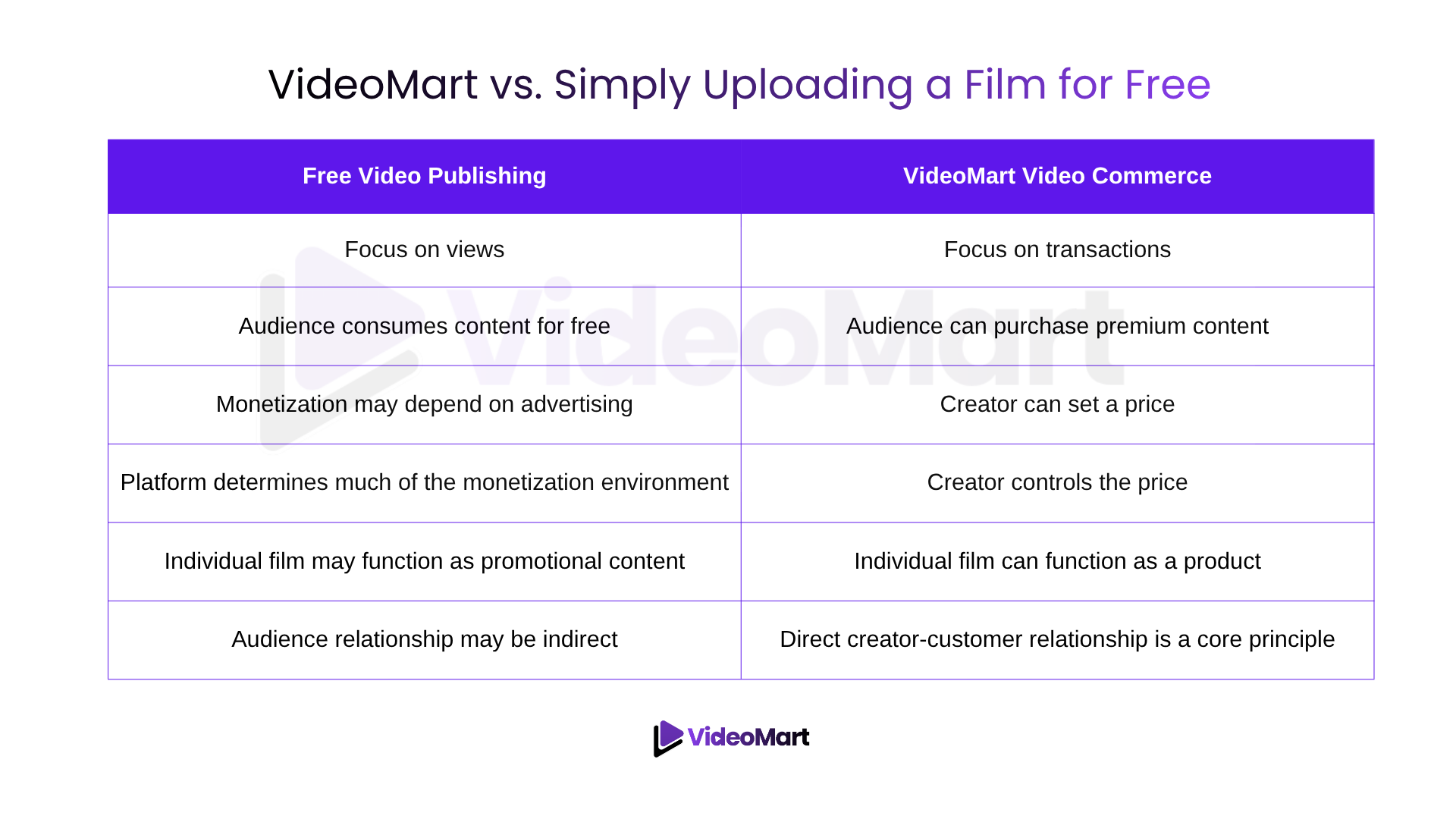
VideoMart's positioning explicitly emphasizes direct monetization, audience ownership, and creator control.
A Practical Filmmaker Launch Checklist
Before publishing a film on VideoMart, a filmmaker should prepare:
Confirm ownership and distribution rights
Keep licensing documentation organized
Prepare the final film master
Prepare a strong poster or thumbnail
Write a clear synopsis
Add accurate film metadata
Prepare subtitles where required
Create a trailer or promotional assets
Decide the film's price
Determine the appropriate monetization model
Upload and complete compliance checks
Promote the film to your existing audience
Monitor discovery, engagement, and sales
Review audience feedback
Continue promoting the film after launch
Why Filmmakers Should Think Beyond "Getting on OTT"
Getting a film onto a major streaming service can sound like the ultimate goal.
But distribution is bigger than platform placement.
A filmmaker also needs to think about:
Ownership.
Pricing.
Audience.
Discovery.
Revenue.
Rights.
Data.
Long-term catalog value.
VideoMart's institutional positioning is deliberately different from an OTT-first model. Its documents instruct that VideoMart should be described as a premium video marketplace and video commerce platform, not simply as an OTT platform.
That distinction is central to understanding the product.
The goal is not merely to host films.
The goal is to create infrastructure through which premium video can be bought, sold, distributed, and monetized directly.
The Bigger Opportunity for Independent Filmmakers
A filmmaker does not necessarily need millions of viewers to create value from a film.
A smaller audience that genuinely values the work can be commercially meaningful.
This is consistent with VideoMart's creator-first communication philosophy: not every creator needs a million views; some may need a smaller audience that actually cares enough to buy.
That leads to a different way of thinking about film distribution:
Don't only chase reach. Build value around the work.
For an independent filmmaker, that can mean building a catalog, developing a recognizable audience, learning what viewers search for, experimenting with pricing, and turning each release into a commercial asset.
Frequently Asked Questions
Is VideoMart only for feature films?
No. VideoMart's Entertainment Mode includes filmmakers alongside web series, micro dramas, animation, regional entertainment, events, performances, sports, and other premium entertainment categories.
Can filmmakers set their own film prices?
Yes. VideoMart's documented creator workflow allows creators to set pricing for individual videos.
How much does VideoMart charge filmmakers?
The current knowledge base states that the standard commission is 20%, with creators keeping 80%. It also documents an introductory 0% commission offer on the first ₹20,000 in sales or six months.
When do filmmakers receive payouts?
The knowledge base states that creator payouts are made weekly, with payouts every Monday.
Can viewers buy individual films?
Yes. VideoMart's TVOD and pay-per-view models are designed around transactions for individual premium videos.
Does VideoMart provide copyright protection?
Its documented infrastructure includes AI copyright monitoring, secure distribution, DRM and anti-piracy systems, along with manual review and rights-holder reporting mechanisms.
Does VideoMart guarantee that a film will become successful?
No such guarantee is supported by the knowledge base. VideoMart provides distribution, monetization, discovery, analytics, and related infrastructure, but audience demand and commercial performance depend on the film, pricing, marketing, audience, and other factors.
Key Takeaways
VideoMart is designed to give filmmakers a direct route from creating a film to selling it as a premium digital experience.
The core workflow is:
Register → Upload → Price → Publish → Discover → Sell → Earn
The platform's documented filmmaker proposition includes:
Direct monetization
Creator-controlled pricing
TVOD and pay-per-view
Creator channels
Search and discovery
Analytics
Built-in payments
Weekly payouts
Secure distribution
AI copyright protection
Direct creator-customer relationships
The bigger idea is simple:
Your film is not just something to upload. It is something you can sell.
VideoMart exists to help make that transaction possible.
Sell Videos. Not Just Views.