The Biggest Misconception: Owning an OTT Platform Equals Owning Your Business
Many people believe that building an OTT platform automatically gives them ownership over their content business.
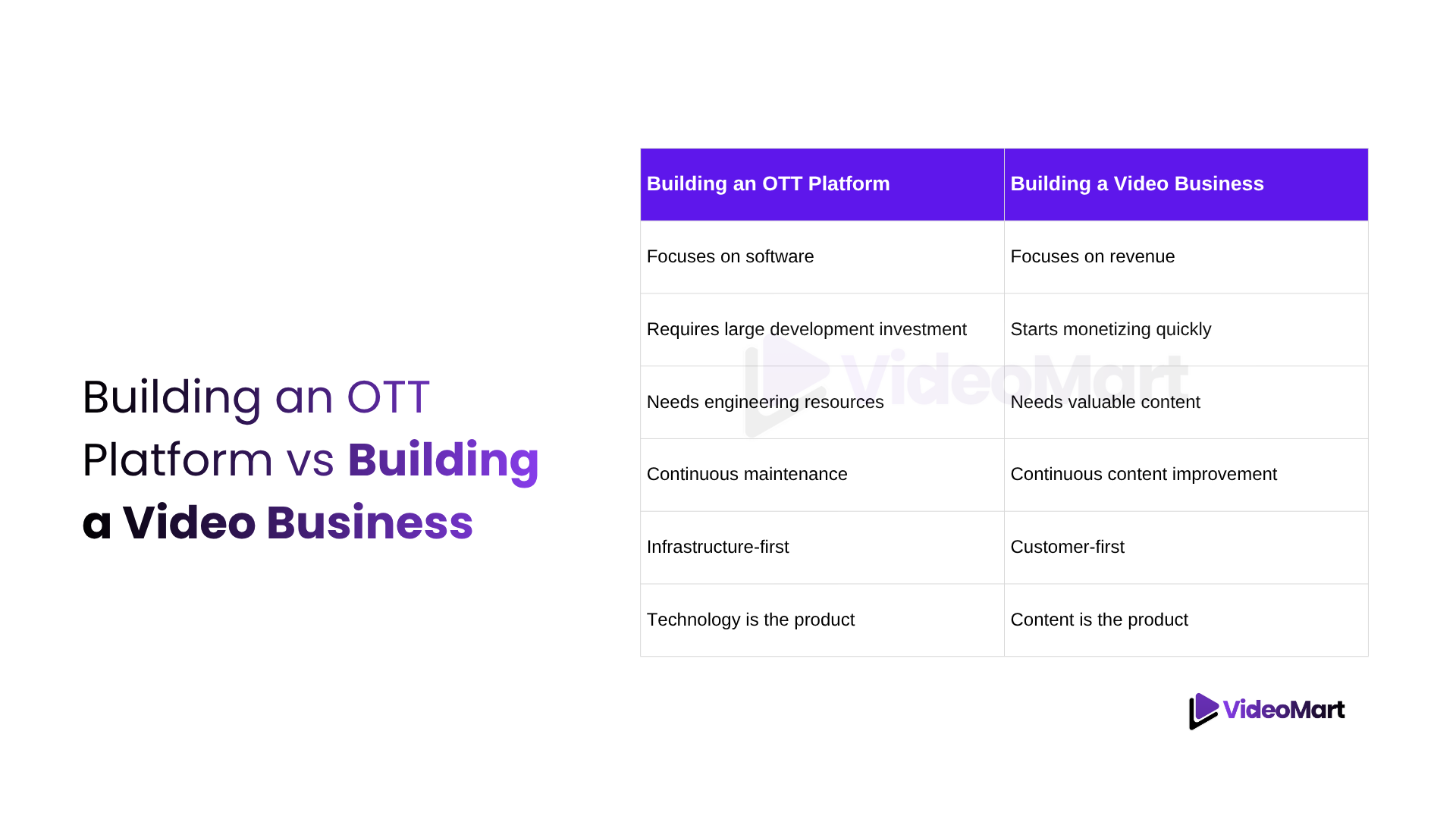
In reality, an OTT platform is simply the technology that delivers video.
It doesn't guarantee:
Customers
Revenue
Discovery
Payments
Commerce
Pricing flexibility
Sustainable monetization
Technology alone doesn't build a business.
A business is built around how customers discover, buy, and consume your content.
That's why many expensive OTT projects fail long before they recover their development costs.
What Most Content Owners Actually Want
When creators say they want an OTT platform, they're usually trying to solve one or more of these problems:
Sell premium videos directly
Earn more than advertising revenue
Avoid platform algorithms
Control pricing
Reach paying audiences
Protect copyrighted content
Own customer relationships
Build recurring revenue
Notice something?
None of these objectives require building an OTT platform from scratch.
They require a video commerce strategy.
VideoMart's philosophy reflects this distinction: videos should be treated as products, creators as merchants, and audiences as customers—not simply viewers.
The Hidden Costs of Building Your Own OTT Platform
The initial development budget is only the beginning.
You'll also need to manage:
Video hosting infrastructure
Adaptive streaming
Payment gateways
DRM implementation
Security updates
Mobile applications
Smart TV applications
Recommendation systems
Search functionality
Analytics
User management
Subscription billing
Compliance
Customer support
Continuous feature development
Instead of producing better content, your team gradually becomes a software company.
For many creators, that's not the business they intended to build.
The Real Question Isn't "Should I Build an OTT Platform?"
A better question is:
What business am I trying to build?
If you're a:
Filmmaker
Production house
Coach
Educator
Studio
Music label
Sports organization
Event organizer
...your competitive advantage isn't software development.
It's creating premium experiences people are willing to pay for.
Why Video Commerce Is Becoming More Important Than Streaming
Streaming made video accessible.
Commerce makes it sustainable.
Consumers increasingly prefer paying for exactly what they value rather than accumulating multiple subscriptions.
Creators want predictable income instead of depending entirely on advertising or recommendation algorithms.
That's why Transactional Video on Demand (TVOD), pay-per-view, premium purchases, and creator-owned commerce are becoming increasingly attractive monetization models.
VideoMart is designed around this philosophy by enabling creators and organizations to upload, price, distribute, and monetize premium video experiences directly rather than positioning itself as a traditional OTT service.
When Building Your Own OTT Platform Makes Sense
Building your own platform may be justified if you have:
Millions of expected users
Dedicated engineering teams
Long-term infrastructure budgets
Unique platform requirements
Enterprise-level distribution needs
Complete ownership over customer acquisition
Examples include:
Large broadcasters
National television networks
Major sports leagues
Global media enterprises
For everyone else, custom development often becomes an unnecessary distraction.
What Growing Content Businesses Should Prioritize Instead
Rather than asking, "How do we build Netflix?"
Ask:
How do we sell more premium videos?
How do we increase customer lifetime value?
How do we price our content effectively?
How do we protect our intellectual property?
How do we build direct relationships with buyers?
How do we expand globally?
Those questions generate revenue.
The platform should support those goals—not become the goal itself.
Ownership Doesn't Mean Building Everything Yourself
There's an important distinction between platform ownership and business ownership.
Business ownership means:
Owning your audience
Setting your own prices
Keeping control of your brand
Managing customer relationships
Protecting your content
Controlling your monetization strategy
You don't necessarily need to build every technical component yourself to achieve those outcomes.
A Smarter Way to Think About 2027
The next generation of successful creators won't compete by building streaming technology.
They'll compete by building better businesses around premium content.
That means focusing on:
Content quality
Pricing strategy
Audience relationships
Premium experiences
Direct monetization
Sustainable revenue
Technology should enable those goals—not replace them.
As VideoMart's internal positioning emphasizes, it aims to be infrastructure for premium video commerce rather than "merely an OTT platform," reinforcing that monetization and creator ownership take priority over streaming technology itself.
Expert Insight
Many businesses assume they must choose between publishing on free platforms or investing heavily in custom OTT software.
A third approach is emerging: video commerce infrastructure.
Instead of rebuilding streaming technology, creators use platforms designed to handle payments, distribution, content protection, and monetization while allowing them to focus on creating valuable content.
For many organizations, this dramatically reduces technical complexity while accelerating time to market.
Frequently Asked Questions
Is building an OTT platform expensive?
Yes. Beyond initial development, ongoing costs include hosting, streaming infrastructure, security, maintenance, application updates, analytics, payment systems, and customer support.
Is OTT still growing in 2027?
Yes, but consumer behavior is evolving. Many audiences increasingly prefer flexible purchasing models such as pay-per-view, transactional video, and creator subscriptions rather than adding more platform-wide subscriptions.
What's the difference between an OTT platform and a video commerce platform?
An OTT platform focuses primarily on streaming content. A video commerce platform focuses on helping creators distribute, price, sell, and monetize premium video experiences while managing customer relationships and transactions.
Who should build their own OTT platform?
Generally, only organizations with large engineering resources, significant budgets, and specialized infrastructure requirements should consider building a fully custom OTT platform.
Key Takeaways
Building software is not the same as building a profitable content business.
Most creators need better monetization—not custom streaming infrastructure.
Video commerce is becoming a stronger long-term strategy than relying solely on subscriptions or advertising.
Focus on audience ownership, pricing, premium content, and sustainable revenue before investing in custom technology.
The right platform should accelerate your business—not become your biggest project.
Conclusion
The question isn't whether you can build your own OTT platform in 2027.
The question is whether you should.
For most creators, educators, filmmakers, and media businesses, the smartest investment isn't another streaming platform.
It's building a business where premium content is easy to discover, easy to buy, and profitable to sell.
Technology should remove friction—not become the business itself.
.png)